“And the Word became flesh and dwelt among us…”
— John 1:14, ESV
The Mother of Sorrows knows the body.
Not the body as theory.
Not the body as doctrine.
Not the body as a debate.
The body as weight.
The body as warmth.
The body as hunger.
The body as breath.
The body as skin beneath her hands.
The body as a child held against her chest.
The body as a son growing taller, stronger, stranger, more clearly given to a road she could not control.
Mary knew the body of Christ before the world knew His name.
She knew Him before the crowds, before the healings, before the sermons, before the accusations, before the Cross, before the tomb, before the Church knew how to speak of Him.
She knew His kicks beneath her ribs.
She knew the ache of carrying Him.
She knew the risk of birthing Him.
She knew the milk, the cloth, the washing, the rocking, the fevered nights, the ordinary human care that does not look like theology until you realize God chose to need it.
That is the scandal of the Incarnation.
God needed to be held.
God needed to be fed.
God needed His face wiped.
God needed sleep.
God needed a mother.
Sometimes Christianity becomes so eager to proclaim the glory of Christ that it forgets the weight of Him in Mary’s arms.
But she did not forget.
A mother does not forget the weight of her child.
She knew the body.
And because she knew the body, she knew something about God that no abstract theology can safely ignore:
God does not despise flesh.
God entered it.
“For you formed my inward parts; you knitted me together in my mother’s womb.”
— Psalm 139:13, ESV
That line has followed me for a long time.
Knitted.
Not manufactured.
Not tolerated.
Not temporarily housed in something shameful.
Knitted.
There is tenderness in that word.
Intention.
Patience.
A hidden artistry.
The body is not some unfortunate container for the soul. It is not trash. It is not a mistake. It is not an embarrassment God has to work around.
The body is created.
The body is formed.
The body is part of the mystery of being human before God.
That matters to me because so much bad religion has taught people to distrust, hate, punish, control, or erase the body.
Especially bodies that do not fit the approved shape.
Queer bodies.
Disabled bodies.
Fat bodies.
Sick bodies.
Aging bodies.
Poor bodies.
Brown bodies.
Black bodies.
Trans bodies.
Bodies with scars.
Bodies with desire.
Bodies with illness.
Bodies that cannot perform strength.
Bodies that make respectable people uncomfortable.
The Church has not always known what to do with bodies.
Sometimes it has blessed them.
Sometimes it has fed them.
Sometimes it has washed them.
Sometimes it has anointed them.
Sometimes it has buried them with reverence.
And sometimes it has shamed them, controlled them, violated them, excluded them, or treated them as problems to be managed.
But Mary knows better.
She knows the body is holy because she carried the Holy One in hers.
She knows the body is vulnerable because she watched His body suffer.
She knows the body is worthy of reverence because she held the body of Christ after the world had done its worst to Him.
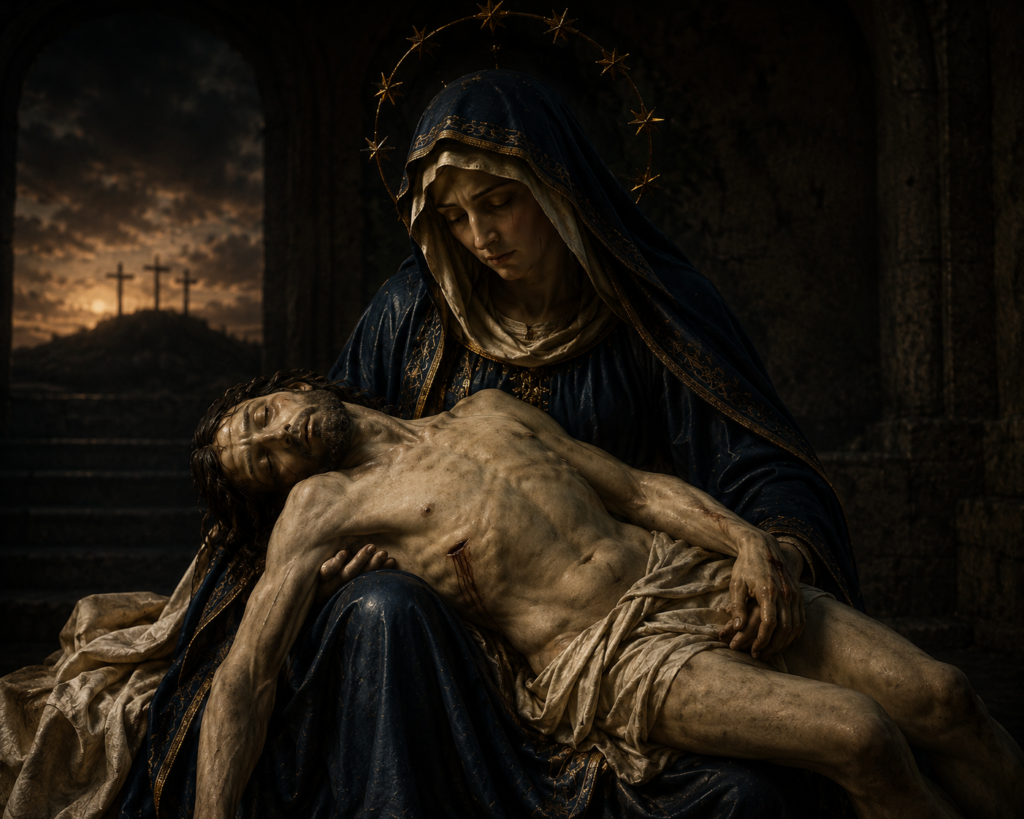
That image breaks me open.
Mary holding the dead body of Jesus.
The Pietà is not just art.
It is theology in grief.
It is the Mother who once held the infant now holding the corpse.
It is the womb and the tomb meeting in her lap.
It is Christmas and Good Friday collapsing into one impossible tenderness.
It is the body of God returned to the arms that first received Him.
She does not say, “It is only flesh.”
She does not say, “The soul is what matters, so do not grieve the body.”
She does not say, “This body is finished, so it no longer deserves love.”
She holds Him.
That is the sermon.
She holds Him.
And in that holding, she teaches the Church how to treat every body.
The dying body.
The dead body.
The wounded body.
The forgotten body.
The body no one claims.
The body in the hospital bed.
The body in the funeral home.
The body at the morgue.
The body lowered into earth.
The body returned to dust.
The body that carried a person through this difficult, beautiful, brutal world.
A priest at the veil must know this.
If I am being called to care for the dying, the departed, the grieving, and the forgotten, then I cannot treat bodies as secondary. I cannot speak only of souls as if the body were an inconvenience left behind.
The soul matters.
Yes.
The soul is commended to God.
The soul is prayed for.
The soul is entrusted to mercy.
But the body matters too.
The body carried the soul.
The body bore the life.
The body suffered the illness.
The body held the memories.
The body worked, loved, sinned, repented, laughed, wept, endured, reached, trembled, embraced, and prayed.
The hands folded on the chest once touched someone.
The mouth once spoke someone’s name.
The feet once carried burdens no one else saw.
The heart once beat through fear and hope.
The skin once knew sunlight.
The bones held a life upright.
The body is not nothing.
And death does not make it nothing.
Christianity should know this better than anyone.
We are not saved by an idea floating above flesh.
We are saved by the Word made flesh.
By a body born.
A body broken.
A body buried.
A body raised.
“This is my body, which is given for you.”
— Luke 22:19, ESV
This is my body.
Not this is my metaphor.
Not this is my concept.
Not this is my religious symbol without cost.
This is my body.
The Eucharist has taught me this, even when I have been far from the altar.
Especially then.
The ache for the Eucharist is an ache for Christ’s embodied gift. Bread in the hand. Wine on the tongue. Matter touched by promise. Creation gathered into offering. The body given so that bodies may be fed with divine life.
That is why the altar matters.
That is why the body matters.
That is why death matters.
That is why burial matters.
That is why graveyards feel holy to me.
They are not empty places.
They are fields of bodies waiting in God’s memory.
Some remembered by families.
Some forgotten by the world.
Some loved well.
Some abandoned.
Some buried under polished stone.
Some under markers no one can read anymore.
Some known only to God.
But none are trash.
None are merely gone.
None are outside the reach of the One who entered the grave.
The Mother who knows the body stands near them.
I believe that.
I believe she stands near hospital beds, funeral homes, cemeteries, accident sites, nursing homes, deathbeds, morgues, and quiet rooms where someone has just taken their last breath.
Not because she replaces Christ.
Because she remembers how to hold what death has touched.
She remembers how to remain when the body has become too honest for polite religion.
She remembers how to love without being able to fix.
She remembers the weight.
That word keeps coming back.
Weight.
A living child has weight.
A dying person has weight.
A dead body has weight.
Grief has weight.
Ministry has weight.
Love has weight.
The body teaches us that love is not abstract.
You cannot love a body only in theory.
You feed it.
Wash it.
Anoint it.
Dress it.
Sit beside it.
Carry it.
Bury it.
Visit it.
Remember it.
Pray for the one who lived in it.
This is where my understanding of ministry keeps deepening.
To care for the departed is not to become morbid.
It is to become reverent.
It is to say that God’s creation remains worthy of tenderness all the way to the end, and beyond what we call the end.
When Scripture says, “for you are dust, and to dust you shall return,” it is not only a curse to me. It is also humility. It is truth. It is ecology. It is the body returning to the creation from which it was formed.
“For you are dust, and to dust you shall return.”
— Genesis 3:19, ESV
Dust is not disgrace.
Dust is origin.
Dust is earth.
Dust is creatureliness.
Dust is the reminder that I did not make myself and cannot preserve myself forever.
The body returns.
The earth receives.
Life continues in ways we often refuse to contemplate because modern people do not like to think about decomposition, soil, roots, worms, trees, animals, and the holy recycling of creation.
But I do think about it.
The body returns to the earth.
And in returning, it gives.
Plants grow.
Soil is fed.
Creatures are nourished.
The cycle continues.
Life rises from what has fallen.
This does not erase resurrection.
It deepens my awe of it.
Because resurrection is not God despising dust.
Resurrection is God refusing to abandon it.
The same God who formed humanity from the dust is not confused by our return to it.
The same Christ who entered the tomb is not afraid of decay.
The same Spirit who hovered over the waters can breathe life where there is no life.
So I do not need to fear the body’s return.
I need to honor it.
This is part of what the Sorrowful Mother is teaching me.
The body is not beneath prayer.
The body is not beneath priesthood.
The body is not beneath God.
The body is where God chose to meet us.
In Christ’s body.
In Mary’s body.
In the hungry body.
In the sick body.
In the imprisoned body.
In the wounded body.
In the queer body.
In the dying body.
In the dead body waiting for mercy’s final word.
A Christianity that cannot honor the body cannot fully honor the Incarnation.
A priest who cannot reverence the body cannot stand faithfully at the veil.
This is why I have to keep learning.
This ministry cannot be built on fascination with death.
It has to be built on reverence.
It has to be built on Christ.
It has to be built on the Mother who knows the body.
It has to be built on the understanding that every person who dies was once held in God’s knowledge before any human being knew their name.
It has to be built on humility.
Because a dead body silences arrogance.
A dying body silences performance.
A grieving body silences easy theology.
At the bedside, at the grave, in the funeral home, the big words become smaller.
What remains is simple.
Lord, have mercy.
Christ, have mercy.
Receive this soul.
Honor this body.
Comfort those who mourn.
Remember what the world forgets.
Let the dead rest in peace.
Let the living learn tenderness.
Let the Church remember the flesh.
Mary remembered.
She remembered the body of Christ from womb to tomb.
She teaches me that no body is beneath reverence.
Not the body that has grown old.
Not the body that has been sick.
Not the body changed by medication.
Not the body marked by HIV, cancer, addiction, disability, surgery, trauma, labor, age, or pain.
Not the body shamed by religion.
Not the body hidden by fear.
Not the body no one wanted to touch.
Christ touched bodies.
Christ healed bodies.
Christ fed bodies.
Christ raised bodies.
Christ gave His body.
And Mary held His body.
That is the theology.
That is the mercy.
That is the rebuke to every faith that becomes too clean to touch suffering.
I do not want a clean faith.
I want an incarnate one.
A faith with dirt under its nails.
A faith that can stand at a deathbed.
A faith that can walk through a cemetery.
A faith that can bless a hospital room.
A faith that can pray over ashes.
A faith that can honor a corpse without flinching.
A faith that can say resurrection without disrespecting grief.
A faith that can hold both dust and glory.
That is what the Mother who knows the body is teaching me.
She is teaching me not to look away.
Not from the wounded body of Christ.
Not from my own body.
Not from the bodies of the dying.
Not from the bodies of the dead.
Not from the bodies the world has judged unworthy.
She is teaching me that sorrow becomes holy when it remains in love.
She is teaching me that priesthood near death must be tender, grounded, ethical, humble, and embodied.
She is teaching me that to pray for the departed is also to honor the creation they inhabited.
She is teaching me that the veil is not an escape from the body, but a mystery Christ has already entered bodily.
So I stand under her mantle, learning.
Still learning.
Learning to bless what I cannot fix.
Learning to stay where I used to run.
Learning to care for bodies and souls without trying to become their Savior.
Learning to let Christ be Lord of the living and the dead.
Learning to say, with trembling reverence:
This body mattered.
This life mattered.
This grief matters.
This dust belongs to God.
And the God who became flesh will not forget what He has made.
Scripture quotations are from the ESV® Bible (The Holy Bible, English Standard Version®), © 2001 by Crossway, a publishing ministry of Good News Publishers. ESV Text Edition: 2025.