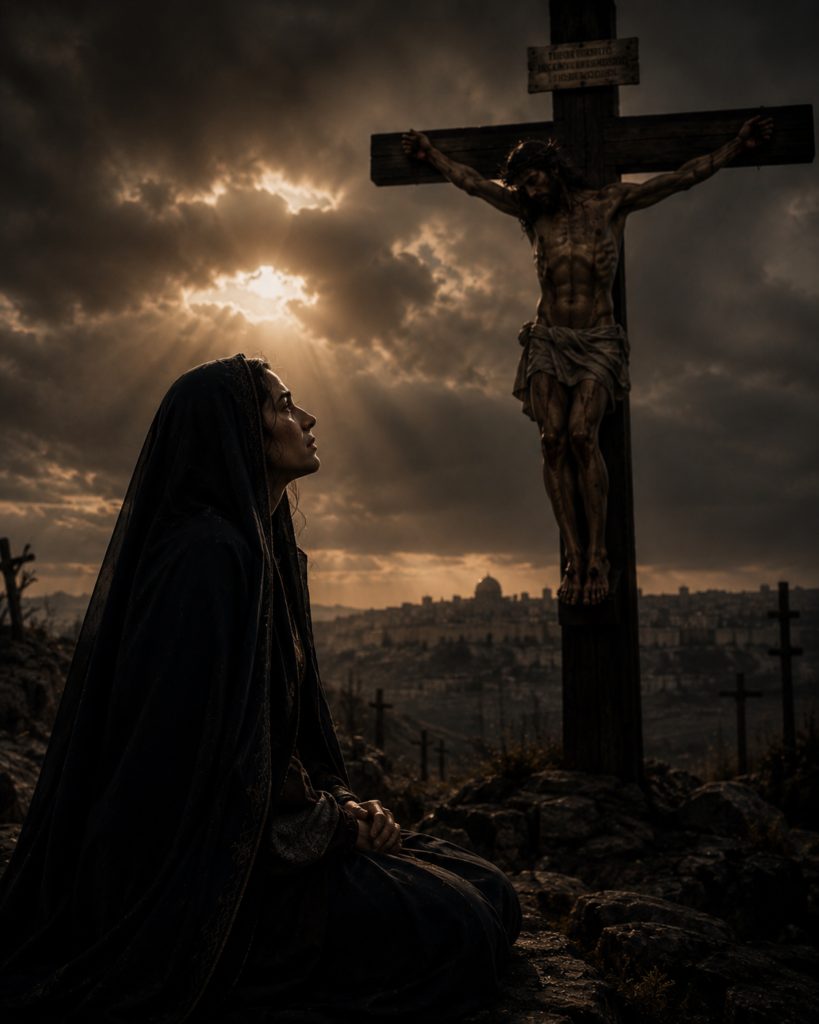
“But standing by the cross of Jesus were his mother…”
— John 19:25, ESV
The Sorrowful Mother did not explain the Cross.
She stood beneath it.
That may be one of the deepest teachings she gives us.
Not a teaching spoken from a pulpit.
Not a doctrine written in careful language.
Not a neat answer wrapped in religious certainty.
A teaching made of presence.
A teaching made of staying.
Mary stood at the place where explanation failed.
She stood at the place where the body of her Son was broken, exposed, humiliated, bleeding, and dying. She stood at the place where the promise looked impossible. She stood at the place where the disciples had mostly scattered, where fear had entered the room of faith, where empire and religion had joined hands to crush the One who came as mercy.
And she did not explain it.
She did not say, “Do not worry, this is all part of the plan.”
She did not rush the other women into Easter language.
She did not make the nails symbolic too quickly.
She did not turn the blood of Christ into theology before allowing it to be blood.
She did not spiritualize the agony away.
She stood.
There are times when standing is the holiest thing a person can do.
That is hard for us, because we are addicted to explanation.
Someone suffers, and we start talking.
Someone dies, and we reach for phrases.
Someone’s world collapses, and we rush to fill the silence with something that sounds faithful.
God has a plan.
Everything happens for a reason.
Heaven needed another angel.
This is your cross to bear.
God never gives you more than you can handle.
Maybe people mean well when they say these things. Maybe they are trying to comfort. Maybe they are frightened by the depth of another person’s pain and do not know what else to offer.
But at the foot of the Cross, many explanations become too small.
Some words should not be spoken too quickly.
Some wounds should not be handled with slogans.
Some suffering must first be witnessed before it can be interpreted.
Mary teaches that.
She does not abandon faith.
She does not abandon God.
She does not deny the mystery of redemption.
But she also does not use theology as an escape hatch from grief.
She stays with the body.
That is the line that keeps returning to me.
She stays with the body.
The body of Christ was not an idea.
It was not a metaphor.
It was not a sermon illustration.
It was flesh.
The flesh she had carried in her womb.
The flesh she had nursed.
The flesh she had washed, held, fed, and watched grow.
The hands that had blessed children.
The mouth that had spoken mercy.
The feet that had walked dusty roads.
The eyes that had looked upon the unwanted.
The body that had touched lepers, broken bread, wept at a tomb, and carried the presence of God into the ordinary world.
That body was now nailed to wood.
Mary did not look away.
This matters.
Because Christianity is not a religion that should despise bodies.
The Word became flesh.
Christ did not save us from a distance.
He entered the body.
He entered hunger.
He entered exhaustion.
He entered tears.
He entered pain.
He entered death.
He entered the grave.
And Mary stood there as witness to the cost of that love.
She teaches us that the body matters, even when the body is dying.
The dead matter.
The grieving matter.
The wounded body is not trash.
The dying body is not an inconvenience.
The corpse is not merely remains.
The body is still part of the story of God’s tenderness.
That is becoming central to me as I discern this ministry of the departed, the dying, the wounded, and the forgotten.
A priest at the veil must learn from Mary before he speaks.
Because if I speak too quickly about resurrection, I may dishonor grief.
If I speak too quickly about heaven, I may fail to honor the body.
If I explain too quickly, I may turn someone else’s wound into my own need to feel useful.
If I rush to meaning, I may skip mercy.
Mary does not skip mercy.
She does not explain the Cross.
She attends it.
She keeps vigil.
She remains.
Her presence says what words cannot say:
This is real.
This is terrible.
This body matters.
This grief matters.
This suffering is not invisible to God.
That is not weakness.
That is strength beyond performance.
Standing at the Cross is not passive.
It is not decorative.
It is not the soft religion of a woman in blue fabric with lowered eyes and no spine.
No.
Mary at the Cross is fierce.
She is the Mother whose soul has been pierced.
“And a sword will pierce through your own soul also…”
— Luke 2:35, ESV
Simeon told her this long before Calvary.
But prophecy does not make pain easy.
Being warned about the sword does not make the blade gentle.
Mary was full of grace, and still the sword pierced.
Mary was chosen, and still she suffered.
Mary belonged to God, and still she stood beneath the dying body of her Son.
That should correct some of our bad theology.
Faith does not mean the sword never comes.
Holiness does not mean the heart cannot break.
Being loved by God does not mean being protected from every sorrow.
Sometimes grace is not the absence of piercing.
Sometimes grace is the strength to remain human after the piercing.
To remain tender.
To remain faithful.
To remain present.
To refuse despair without pretending the wound is not real.
This is where the Sorrowful Mother becomes a teacher for those of us coming through the dark night.
Because the dark night also resists explanation.
I wanted explanations.
I wanted God to tell me why prayer had gone dry.
Why the altar felt behind glass.
Why the Eucharist felt like a boat on the horizon.
Why the ministry I thought I was called to build kept failing to become a road.
Why the old warmth disappeared.
Why I felt like the bad child outside the house.
Why God seemed silent after calling me.
I wanted Christ to explain the Cross in my own soul.
But Mary did not first give me explanation.
She gave me presence.
A mantle.
A nearness.
A quiet, sorrowful steadiness that did not panic when I was angry, wounded, doubtful, or spiritually exhausted.
She stayed.
And slowly I began to understand that maybe some forms of grace do not answer the question immediately.
They keep you alive long enough to keep asking.
Sometimes God’s mercy is not a solution.
Sometimes it is companionship.
A hand on the head.
A candle in the room.
A Mother at the threshold.
A presence that says, “I will not leave you alone with this.”
That does not satisfy every part of me.
I still want answers.
I still want the road clear.
I still want the door open.
I still want the fullness of Christ’s voice, not just hints of Him through saints, nature, sorrow, and silence.
But I am learning that presence is not nothing.
Mary’s standing was not nothing.
Her silence was not nothing.
Her grief was not nothing.
Her refusal to abandon the body of Christ was not nothing.
And perhaps the Church needs to remember this.
Before we preach, we must stand.
Before we explain, we must witness.
Before we speak of resurrection, we must honor the grave.
Before we speak of victory, we must let the mourner weep.
Before we turn suffering into theology, we must ask whether our theology has learned how to kneel.
There is a kind of Christian speech that is true but badly timed.
And truth without tenderness can become another wound.
Mary teaches the timing of mercy.
She teaches that there is Good Friday.
There is Holy Saturday.
There is Easter.
And they are not the same day.
Good Friday is not the day for easy explanations.
Holy Saturday is not the day for forced joy.
Easter comes, but it comes in God’s time.
We do not get to drag grieving people into resurrection before they have had time to stand beside what has died.
That is not faith.
That is impatience wearing religious clothes.
The Sorrowful Mother knows how to wait in the terrible middle.
She knows the space between death and revelation.
She knows what it means to hold faith when faith has no visible evidence except the body of the Beloved and the memory of His words.
She knows what it means to trust without understanding.
That is why she is not sentimental to me.
She is strong medicine.
She is the Mother who teaches holy restraint.
She teaches the priest not to make grief about himself.
She teaches the mystic not to use mystery as a costume.
She teaches the caretaker not to climb onto every cross.
She teaches the wounded child that love can stay.
She teaches the angry soul that silence is not always abandonment.
She teaches the Church that bodies matter.
She teaches the grieving that they do not have to make their sorrow polite.
She teaches those at the veil that Christ has already gone into death and is not afraid of it.
This does not mean the Cross is beautiful in itself.
The Cross saves.
But crucifixion is still evil.
That distinction matters.
God can redeem suffering without making suffering good.
God can bring resurrection without asking us to pretend death is harmless.
God can turn the instrument of execution into the sign of salvation without excusing the cruelty that nailed Christ there.
Mary helps us hold that tension.
She does not look at the Cross and call the violence good.
She looks at her Son.
She loves Him.
She suffers.
She stays.
Only God can make resurrection out of that.
That is not her work to force.
It is not ours either.
Our work is fidelity.
Presence.
Prayer.
Love.
Witness.
Mercy.
The Father of mercies comforts us in affliction so that we may comfort others. But comfort does not always mean explanation. Sometimes comfort is the courage to sit beside the afflicted without trying to control their grief.
That is the ministry I want to learn.
Not to explain every Cross.
Not to make pain neat.
Not to rush the dying, the grieving, the wounded, or the spiritually lost into language they cannot yet speak.
But to stand.
To pray.
To witness.
To honor the body.
To remember the dead.
To keep vigil with the living.
To say, with presence before words:
You are not alone here.
Christ is not absent here.
The Mother stands near.
Your grief does not frighten God.
Your silence does not cancel grace.
Your tears do not make you faithless.
Your wound does not remove you from mercy.
That is what Mary’s silence teaches me.
It is not the silence of emptiness.
It is the silence of love refusing to flee.
Maybe this is what the dark night has been teaching me too.
I do not need to understand everything before I can remain faithful.
I do not need to explain every wound before I can bless it.
I do not need to solve grief before I can sit beside it.
I do not need to control the veil before I can pray at it.
I do not need to become Christ in order to serve Christ.
I need to stay where He sends me.
And if He sends me to the dying, the dead, the grieving, and the forgotten, then I must go there in Mary’s school.
Not with noise.
Not with ego.
Not with easy answers.
With a candle.
With a prayer.
With reverence.
With humility.
With enough courage to keep my mouth shut when silence is holier than speech.
With enough faith to say, when the time comes:
Lord, have mercy.
Christ, have mercy.
Receive this soul.
Comfort this grief.
Honor this body.
Stand near this wound.
Remember Your dead.
Do not let death pretend to be God.
Do not let sorrow become the final word.
Mary did not explain the Cross.
She stood beneath it.
And maybe that is why she can teach us how to survive ours.
Not by making pain noble.
Not by making grief pretty.
Not by pretending resurrection cancels the wound.
But by staying close to Christ when the world has done its worst.
By refusing to abandon the body.
By holding silence until God speaks.
By trusting that even when heaven seems quiet, love has not left.
So I am learning.
Slowly.
Imperfectly.
As a priest.
As a child.
As one still coming out of the dark.
I am learning not to explain every Cross.
I am learning to stand.
I am learning to stay.
I am learning that presence may be the first language of mercy.
And under the mantle of the Sorrowful Mother, I am learning that some ministries are not born from answers.
They are born from wounds that did not make us cruel.
They are born from grief that did not make us leave.
They are born from silence held faithfully until resurrection speaks.
Scripture quotations are from the ESV® Bible (The Holy Bible, English Standard Version®), © 2001 by Crossway, a publishing ministry of Good News Publishers. ESV Text Edition: 2025.