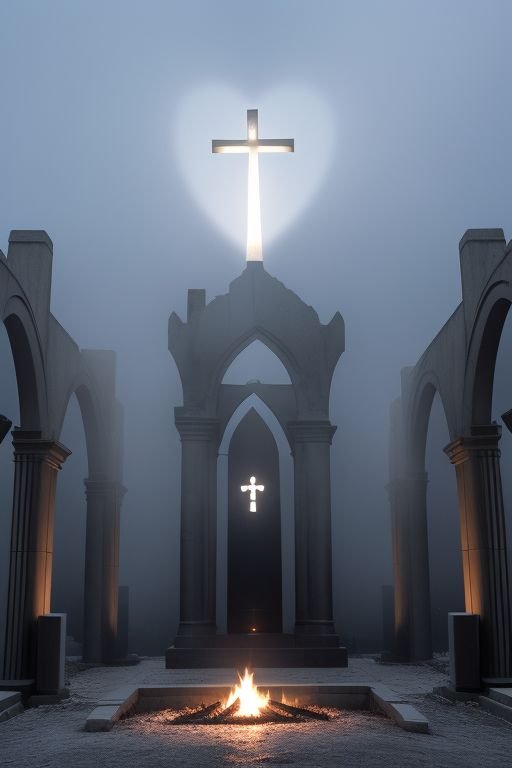
I have been trying to remember why I became a priest in the first place.
Not the paperwork answer.
Not the official answer.
Not the answer that sounds good in a clergy biography.
The real answer.
The one underneath all of it.
I have always believed that a true priest is not someone playing holy dress-up. God knows there is enough of that in the world. A true priest is supposed to be a conduit. A vessel. A cracked wire carrying the light of Christ into places where people have forgotten light can still reach.
A priest is supposed to bring forth the light of Christ.
A priest is supposed to spread the energy of the Eucharist as far around the community as possible.
Not hoard it.
Not control it.
Not turn it into a reward for the respectable.
But carry it outward.
Into streets.
Into homes.
Into hospital rooms.
Into graveyards.
Into queer bodies that were told they were not welcome.
Into the lives of the dying, the forgotten, the spiritually homeless, the ones abandoned by the Church, and the dead who still deserve to have their names prayed before God.
That is what I thought priesthood was.
That is what I still think priesthood is, even now, even in the dark.
I wanted to be a priest for a long time. Maybe always, in some strange way. But for most of my life, the Church made that feel impossible. The Church preached hatred against the “Other,” while pretending it was holiness. It preached fear and called it doctrine. It wounded the very people Christ kept moving toward.
And yes, I am angry about that.
I am angry because so much of that hatred was cowardice dressed up in vestments.
People feared what they did not understand. They feared what they were. They feared the queer child, the outsider, the wounded body, the person who did not fit neatly into their system. And instead of facing their fear, they made theology out of it.
So becoming a priest, even though I felt called, could not happen for a long time.
How do you become a priest in a Church that keeps telling you your existence is the problem?
How do you walk toward an altar when the people guarding it keep looking at you like you are the threat?
And yet the call did not leave.
That is the strange thing.
I left. I wandered. I got angry. I found beauty elsewhere. I learned to survive outside the places that had harmed me.
But the call did not leave.
Then came the Holy Mother and Saint Michael.
Even now, I do not know how to explain it cleanly. I do not know if what I heard was exactly what was spoken, or what my soul understood it to mean. Mystical things are like that. They come whole, and then later the mind has to translate them with its poor little dictionary.
But what I heard, or what I understood, was something like this:
You are loved.
You are needed.
You are a protector of the faith and of God’s people.
You are to beat Satan back.
That sounds dramatic written out.
Maybe it was dramatic.
Maybe grace is dramatic when it has to break through years of shame.
What I remember most is not an argument. It was not a theological lecture. It was love. Confusion, yes. Urgency, yes. But love first.
It felt like swimming in warm honey.
Thick. Golden. Flowing. A complete hug from the inside out.
The kind of love that does not just touch your skin, but gets underneath the places where fear has been living.
And I did not fully understand what was being asked of me.
I still do not.
But I knew I was being called.
I knew I was being told to become a priest.
So I made a promise.
I promised to continue the work of Jesus. To take care of His people. To bring Him to those who wanted Him, needed Him, missed Him, or did not yet know how to ask for Him.
That was the vow beneath the vow.
Not career.
Not status.
Not church politics.
Christ.
His people.
His wounded.
His dead.
His forgotten ones.
I wish I could say I had a detailed ministry plan. I did not. I had no idea what I was doing. I just knew I was being told: become a priest.
The rest was fog.
I thought maybe I would become an exorcist priest. A priest for the fallen. A priest for the dead. A priest who could stand at the edge of the dark and tell whatever was destroying God’s people: you cannot have them.
Maybe that still is the call.
Maybe I just misunderstood what battlefield I would be standing on.
Ordination was heavy. Beautiful. Terrifying.
It felt like a yoke.
It felt like coming home.
It felt like being trusted with fire.
I thought after ordination I would figure out what I was supposed to do. I thought the road would open because God had called me to walk it.
I was wrong.
Or at least, it did not open the way I thought it would.
I tried to build something. A place of God. A congregation. A community. A place where the Eucharist could be offered, where wounded people could come without flinching, where the forgotten would be remembered and the dead would be prayed for.
And nothing.
I have done what I thought I was supposed to do.
Flyers. Cards. Websites. Talking to people. Offering Mass. Showing up. Wearing the collar. Wearing the habit. Trying to be visible enough that the people who needed a priest might find one.
Most of the time, I get scowls.
Averted eyes.
Suspicion.
People have been hurt so badly by the Church that even the sight of a priest can make them brace.
And then there are others who want to talk my face off. They want conversation. They want the idea of a priest. They want access to the collar, maybe. But they do not want Mass. They do not want the Eucharist. They do not want the altar.
And that hurts in a way I do not always know how to name.
Because I did not become a priest to be interesting.
I became a priest to bring Christ.
I became a priest to offer the Eucharist.
I became a priest because I believed mercy needed hands.
So yes, I feel shame.
I feel like a failure.
I feel deep regret that I have not been able to fulfill what was asked of me.
I feel like I was given fire and then left standing in an empty room with no hearth.
What does a priest do with unspent blessing?
What does a priest do when his hands were set apart to carry bread and cup, but no one comes to the table?
What does a priest do when he was called to protect God’s people, but cannot even find where they are gathering?
I do not know.
That may be the most honest answer I have.
I became a priest because God called me to do something.
I do not fully know what.
I thought I would know by now.
I thought the calling would become clearer after ordination, not more confusing. I thought the road would rise up. I thought the people would come. I thought the fire would find somewhere to burn.
Instead, I am here.
Still called.
Still confused.
Still angry.
Still ashamed.
Still hungry for the Eucharist.
Still praying for the dead.
Still wanting to protect the wounded.
Still wanting to beat back whatever evil keeps telling God’s children they are unwanted.
Maybe this is priesthood too.
Not the priesthood I imagined.
Not the priesthood I wanted.
Not the priesthood that looks successful from the outside.
But some hidden, brutal, unfinished priesthood.
A priesthood in the ruins.
A priesthood in the dark.
A priesthood with no congregation except the dead, the wounded, the spiritually homeless, and whoever is reading this because they still miss God but cannot bear church.
I became a priest because I was called.
That is the answer.
Not because I understood it.
Not because I was ready.
Not because I knew how it would work.
God called me to do something.
I still do not know what.
But even in this silence, even in this shame, even in this dark night, some part of me is still listening for the rest of the command.