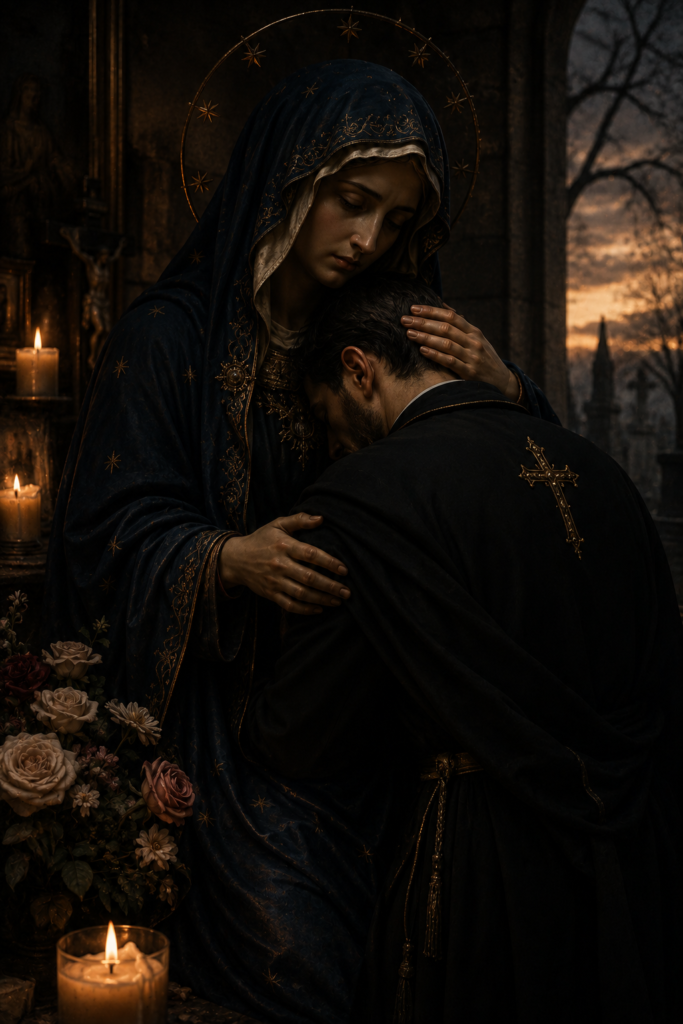
“When Jesus saw his mother and the disciple whom he loved standing nearby, he said to his mother, ‘Woman, behold, your son!’ Then he said to the disciple, ‘Behold, your mother!’”
— John 19:26–27, ESV
There are moments in the spiritual life when comfort does not come as an answer.
It comes as covering.
Not explanation.
Not rescue.
Not the door flying open.
Not the whole road laid out in gold.
Covering.
A mantle drawn around the shoulders of a soul that has been standing too long in the cold.
That is how the Sorrowful Mother has come to me.
Not as a replacement for Christ.
Never that.
She does not stand between me and Jesus as a wall.
She stands near me as a mother.
She takes the shaking child, the wounded priest, the queer soul, the frightened man, the tired caretaker, the one who has prayed into silence until his throat felt scraped raw, and she turns him gently toward her Son.
She does not say, “Look at me instead.”
She says, “Look at Him with me.”
That matters.
Because there have been seasons when looking directly at Christ felt impossible.
Not because I stopped loving Him.
Because I was hurt.
Because I was angry.
Because the silence had become too heavy.
Because the altar felt behind glass.
Because prayer felt like leaving voicemail after voicemail that heaven did not return.
Because the name of Jesus had been used so often by cruel people that some part of me flinched even while another part of me still longed for Him.
The Sorrowful Mother understood that.
She did not scold me for flinching.
She did not shame me for being wounded.
She did not demand that I speak politely before she would come near.
She covered me.
That is what a mantle does.
It does not erase the storm.
It does not pretend the night is not cold.
It does not make the body invincible.
It covers what is exposed long enough for life to remain possible.
I think I have been under her mantle longer than I realized.
From the first call.
From the water.
From the roses.
From the warm honey.
From the sense of being loved before I understood what being called would cost.
From the strange mercy of Saint Michael standing like holy fire beside her.
From the first moment I knew that God had not forgotten me, even when I had wandered far from the Church and nearly out of belief altogether.
She was there.
Not loudly.
Not theatrically.
But there.
And through the dark night, when Christ felt hidden and the old ways of prayer stopped working, she stayed.
That is her way.
She stays.
She stayed at the Cross.
She stayed near the torn body of her Son.
She stayed where the disciples had scattered.
She stayed when the promises looked impossible.
She stayed in the place where love could not fix what love was forced to witness.
That kind of staying is not passive.
It is not weak.
It is not decorative.
It is fierce.
There is a strength in Mary that sentimental religion often forgets. She is not merely soft blue fabric and lowered eyes. She is the woman who carried God in her body. She is the mother who fled violence with her child. She is the woman who pondered mysteries she could not control. She is the mother whose soul was pierced. She is the one who stood upright beneath the empire’s instrument of torture while her Son died.
That is not fragility.
That is holy endurance.
And maybe that is why I trust her.
Because she knows what it means to love God and still suffer.
She knows what it means to be chosen and still be pierced.
She knows what it means to be close to Christ and still not be spared sorrow.
She knows that divine favor does not always look like protection from pain.
Sometimes divine favor looks like strength enough to remain when everything in you wants to collapse.
“And a sword will pierce through your own soul also…”
— Luke 2:35, ESV
I used to hear that verse as prophecy only.
Now I hear it as kinship.
A sword will pierce your soul.
Not because you are abandoned.
Not because you are cursed.
Not because God has stopped loving you.
But because love, in this world, will wound you.
Because to belong to Christ is not to become numb.
Because the closer we stand to the suffering body, the more deeply we feel the blade.
The Mother of Sorrows knows the soul-piercing place.
She knows the place where prayer has no good words left.
She knows the place where the body of the Beloved is broken and heaven seems quiet.
She knows the place where the faithful heart asks, “How can this be God’s will?” and receives no easy answer.
I have lived there.
Maybe not as she lived there.
No one suffers Calvary the way Mary suffered Calvary.
But I have known something of the spiritual sword.
The sword of Church wounds.
The sword of queer shame.
The sword of rejection.
The sword of silence.
The sword of illness.
The sword of failed ministry.
The sword of watching the world twist Christ into something cruel.
The sword of wondering whether God called me and then left me standing outside the locked door.
And in all of that, she has been near.
Under her mantle, I did not become instantly peaceful.
That is important.
Her mantle is not spiritual anesthesia.
It did not remove my anger.
It did not remove my questions.
It did not make the dark night pretty.
It did not turn suffering into a devotional postcard.
Instead, her mantle gave me somewhere to suffer honestly.
A place to be wounded without being ashamed of the wound.
A place to grieve without being rushed.
A place to rage without being abandoned.
A place to say, “I cannot feel Christ right now,” while still being held near Him.
That is mercy.
Sometimes mercy is not the pain ending.
Sometimes mercy is not having to endure the pain uncovered.
I think of her mantle as a kind of chapel.
Not a building.
Not walls.
Not stained glass.
A chapel made of presence.
A hidden space where the soul can breathe, weep, confess, and slowly remember that it is not alone.
Under her mantle, the false self begins to loosen.
The acceptable Christian.
The good son.
The tireless caretaker.
The priest who thought he had to save the world.
The gay man taught to hide.
The wounded child trying to earn love by being useful.
The angry prophet carrying every injustice in his ribs.
All of them are gathered there.
Not condemned.
Gathered.
Mary does not sneer at the false selves we built to survive.
She understands survival.
She knows what it is to protect a child from Herod.
She knows exile.
She knows fear.
She knows the long road.
She knows what it means to carry God in a dangerous world.
So I do not imagine her ripping those false selves away with contempt.
I imagine her touching each one with sorrowful tenderness and saying:
This kept you alive.
But it cannot lead you all the way home.
That is the difference between shame and healing.
Shame says, “You are disgusting for having needed protection.”
Healing says, “You needed this once, but now Christ is calling you deeper.”
Under her mantle, I am learning that I do not have to hate the parts of me that were afraid.
I can bless them.
I can thank them.
I can release them.
I can let the frightened child stop running the whole house.
I can let the caretaker put down some bags.
I can let the priest stop performing competence.
I can let the queer man stand in the light without apologizing for existing.
I can let the old Christian image die so the living Christ can form something truer.
That is the work happening under her mantle.
Not escape.
Formation.
Mary is not hiding me from Christ.
She is preparing me to face Him without the armor.
There is a line between being covered and being hidden.
For a long time, I hid.
I hid my sexuality.
I hid my wounds.
I hid my anger.
I hid my doubt.
I hid my loneliness.
I hid the parts of me that did not fit the version of Christianity I was told was acceptable.
But her mantle is different.
Her mantle does not hide the truth.
It shelters the truth until it is strong enough to stand.
A seed is hidden in the earth, but not because it is shameful.
It is hidden because it is becoming.
Maybe that is what has been happening to me.
I thought I was buried.
Maybe I was planted.
I thought the dark night was only loss.
Maybe some of it was soil.
I thought the silence meant nothing was happening.
Maybe roots were moving where I could not see.
St. Hildegard would probably laugh and tell me to look at the greenness.
She would remind me that the life of God does not always announce itself first as light. Sometimes it comes as sap, as root, as rain, as the stubborn green force pushing through what looked dead.
The Sorrowful Mother and Hildegard together have become a strange mercy to me.
Mary teaches me to stay at the Cross.
Hildegard teaches me to notice the green shoot near the tomb.
Mary teaches me that sorrow must be honored.
Hildegard teaches me that sorrow must not become my whole religion.
Mary teaches me to stand near the dead.
Hildegard teaches me that creation is still alive.
Mary covers the wound.
Hildegard points to the healing herb growing beside it.
And both lead me back to Christ.
Always Christ.
That is the test of any devotion, any vision, any saint, any mystical encounter, any spiritual consolation.
Does it lead me toward Christ?
Does it make me more merciful?
Does it make me more truthful?
Does it make me less afraid of love?
Does it make me more willing to serve?
Does it deepen humility?
Does it widen compassion?
Does it bear fruit?
The Sorrowful Mother has not made me less Christian.
She has made me more honest about the Christ I follow.
The Christ who had a Mother.
The Christ who had a body.
The Christ who bled.
The Christ who died.
The Christ whose corpse was held.
The Christ whose tomb was not metaphorical.
The Christ who rose with wounds still visible.
This matters for the ministry that seems to be forming in me.
Because I am beginning to understand that I am called toward the dying, the departed, the grieving, the forgotten, and the wounded.
A ministry at the veil.
A ministry of holy staying.
A ministry that cannot be done from performance.
A ministry that cannot be done by someone trying to look impressive.
A ministry that requires reverence for the body and tenderness toward the soul.
Who better to teach that than the Mother who held the body of Christ?
She knows that the body is not trash.
She knows that the dead are not nothing.
She knows that grief is not weakness.
She knows that love does not stop at the last breath.
She knows that the silence between death and resurrection must be honored.
Under her mantle, I am learning the ethics of sorrow.
Do not rush grief.
Do not make someone else’s death about your spiritual ego.
Do not turn mystical sensitivity into authority.
Do not talk when silence is the better prayer.
Do not use death to feel special.
Do not call yourself strong because you are numb.
Do not confuse compassion with control.
Do not climb onto every cross.
Stay where Christ sends you.
Leave what belongs to God in God’s hands.
That last lesson is hard.
Leave what belongs to God in God’s hands.
I have spent so much of my life trying to carry what was not mine.
Trying to fix.
Trying to save.
Trying to manage outcomes.
Trying to prevent pain.
Trying to be useful enough to earn my place.
Trying to keep everyone else alive inside my chest.
But Mary stood at the Cross without becoming the Savior.
That is a holy distinction.
She loved perfectly.
She suffered deeply.
She remained faithfully.
But she did not take Christ’s place.
She did not try to become the Redeemer.
She let God be God.
I need that lesson.
If I am going to serve the dying and the departed, I cannot become inflated by sorrow. I cannot imagine myself as the one who controls the veil. I cannot pretend my prayers force mystery to obey me.
I am a priest.
I am not Christ.
I am a servant.
I am not the Savior.
I can pray.
I can bless.
I can hold vigil.
I can commend.
I can remember.
I can ask mercy.
I can stand under her mantle and point toward her Son.
But I cannot own the souls.
I cannot control the passage.
I cannot make death obey my feelings.
I cannot save anyone by my own power.
There is relief in that.
A strange, holy relief.
The mantle does not make me powerful.
It makes me small enough to be useful.
Small enough to listen.
Small enough to kneel.
Small enough to whisper, “Lord, have mercy,” and mean it.
Small enough to understand that one candle is not failure.
One prayer is not failure.
One grave tended is not failure.
One name spoken before God is not failure.
One soul remembered is not failure.
The world wants scale.
Christ wants faithfulness.
The world wants platforms.
Christ wants servants.
The world wants noise.
The veil requires quiet.
Under her mantle, I am being taught quiet.
Not silence as suppression.
Not silence as fear.
Quiet as reverence.
Quiet as readiness.
Quiet as the posture of one who knows he is standing near mysteries larger than himself.
“Be still, and know that I am God.”
— Psalm 46:10, ESV
That stillness has been difficult for me.
I am a person with a racing mind, a wounded heart, a body that carries more than people can see, and a soul that has spent years trying to interpret every silence before it destroys me.
Stillness has not always felt like peace.
Sometimes stillness felt like abandonment.
But under her mantle, stillness feels different.
It feels less like being ignored.
More like being held in a room where not everything needs to be answered at once.
Maybe that is what a mother gives.
A place where the child does not need to solve the whole world before being allowed to rest.
I keep returning to the image of being one of her children.
Not in a childish way.
Not in a way that avoids adulthood or priesthood or responsibility.
But in the deepest Christian sense: I am not self-made. I am not self-sustaining. I am not spiritually orphaned.
At the Cross, Jesus gives His Mother to the beloved disciple.
“Behold, your mother.”
I know the theological interpretations are many.
I know traditions understand that moment in different ways.
But devotionally, mystically, personally, that word has become alive in me.
Behold, your mother.
Not because Christ is insufficient.
Because Christ is generous.
He gives from the Cross.
Even while dying, He creates family.
Even while suffering, He entrusts care.
Even while pierced, He gathers the lonely into relationship.
That means something to me.
As a queer man.
As a priest.
As someone who has felt spiritually homeless.
As someone who has stood outside the house feeling like the bad child.
As someone who has wondered whether God remembered his name.
Behold, your mother.
You are not motherless in the dark.
You are not uncovered at the threshold.
You are not alone beside the Cross.
You are not abandoned at the tomb.
You are not left to figure out sorrow without someone who knows the road.
Under her mantle, I am beginning to believe that.
Not every day with full confidence.
But more than before.
Her mantle does not remove the need for Christ’s voice.
I still long for Him.
I still need Him.
I still ache for the Eucharist.
I still want the door open.
I still want the altar.
I still want the warmth.
I still want the fullness of the Light.
But I no longer feel quite so alone while waiting.
That is no small thing.
For a soul that has known the dark night, companionship is not decorative.
It is survival.
The Sorrowful Mother has been survival for me.
A survival made of roses, tears, steadiness, silence, and the severe mercy of being led back to Jesus when I was too wounded to walk straight.
I do not know all that this means yet.
I do not know what the ministry will look like.
I do not know how the work with the dying and departed will unfold.
I do not know whether there will be a chapel, a community, a rule, a liturgy, a prayer list, a hospice door, a funeral home door, or something I cannot yet imagine.
But I know this:
I am under her mantle.
And under her mantle, I am being formed.
Not protected from all pain.
Not excused from obedience.
Not hidden from Christ.
Formed.
Formed into a priest who can stand near sorrow without worshiping sorrow.
Formed into a servant who can love without becoming the Savior.
Formed into a child who can receive care without earning it.
Formed into a queer Christian who does not have to apologize for being knit together by God.
Formed into someone who can pray for the dead without becoming lost among them.
Formed into someone who can look at the Cross, the tomb, the grave, the hospital bed, the wounded body, the forgotten soul, and still say:
Christ is here.
Not always felt.
Not always understood.
Not always visible.
But here.
And the Mother stands near.
So I will stay beneath her mantle for as long as Christ allows.
I will let her teach me the ministry of staying.
I will let her teach me reverence for the body.
I will let her teach me how to grieve without despair.
I will let her teach me how to carry sorrow without making sorrow my god.
I will let her teach me how to walk toward Christ again.
And maybe that is enough for today.
Not the whole road.
Not the whole answer.
Not the whole resurrection.
Just enough covering to keep walking.
Just enough tenderness to keep listening.
Just enough sorrow to remain honest.
Just enough light to know where she is pointing.
Toward Him.
Always toward Him.
Scripture quotations are from the ESV® Bible (The Holy Bible, English Standard Version®), © 2001 by Crossway, a publishing ministry of Good News Publishers. ESV Text Edition: 2025.