“Jesus said to her, ‘I am the resurrection and the life. Whoever believes in me, though he die, yet shall he live.’”
— John 11:25, ESV
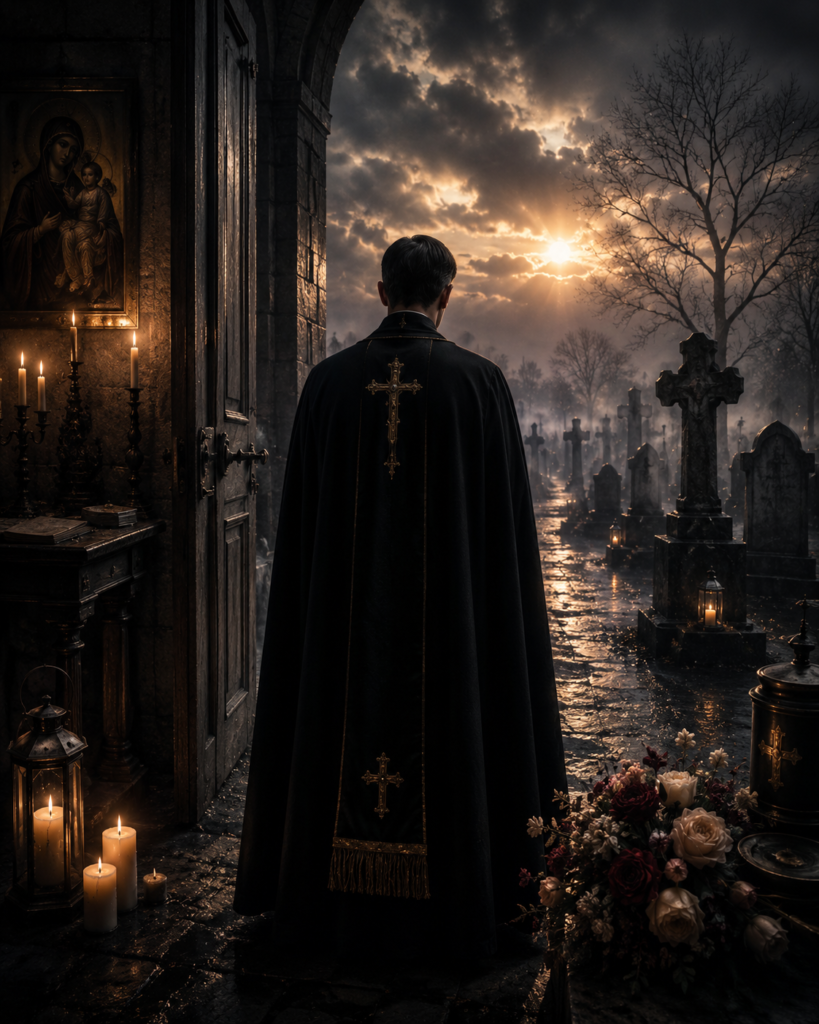
I am beginning to understand that some priesthoods are lived at the veil.
Not above it.
Not safely away from it.
Not in denial of it.
At it.
At the thin place between breath and silence.
At the hospital bed.
At the grave.
At the funeral home.
At the cemetery where names lean under weather.
At the bedside where family members do not know what to do with their hands.
At the edge where the soul begins to loosen from the body and the body begins its final sermon of humility.
This is not the priesthood I imagined when I first said yes.
I thought priesthood would be more visible.
A congregation.
A building.
A full altar.
A calendar.
People arriving with questions, needs, and hunger.
A ministry that could be explained neatly to someone over coffee.
But Christ has not led me neatly.
He has led me through silence, failure, blocked doors, old wounds, spiritual exhaustion, and the strange mercy of being stripped down to what was actually true.
And what is true is this:
I am drawn to the dying.
I am drawn to the dead.
I am drawn to the wounded and the forgotten.
I am drawn to the threshold where people become honest because death has removed the costume.
At the veil, there is no impressive self left to perform.
Titles thin out.
Money quiets.
Arguments shrink.
Bodies tell the truth.
The breath becomes precious.
The room becomes holy in a way no one planned.
And suddenly, what matters is very simple.
Mercy.
Presence.
Prayer.
Forgiveness, if it can come.
A hand held without explanation.
A name spoken before God.
A body treated with reverence.
A soul commended into the mercy of Christ.
That is the work I keep seeing.
Not loudly.
Not with fireworks.
Not with the world clapping.
But clearly.
A priest at the veil does not come to control death.
No priest can do that.
Death is not a problem we solve by being religious enough.
It is a threshold we approach with trembling, reverence, and hope.
A priest at the veil comes to witness.
To bless.
To pray.
To remember.
To stand beside the body and say, by presence if not always by words:
You are not trash.
You are not forgotten.
You are not merely a medical event.
You are not merely paperwork.
You are not merely remains.
You were knit together by God.
You carried breath.
You carried sorrow.
You carried work, laughter, illness, love, shame, fear, touch, memory, hunger, and hope.
Your body mattered.
Your soul matters.
May Christ receive you.
May mercy find you.
May light surround you.
May the Sorrowful Mother stand near you.
That is holy work.
Maybe hidden work.
Maybe strange work.
Maybe work that makes some people uncomfortable because we live in a culture that tries to hide death behind doors, curtains, euphemisms, stainless steel, and paperwork.
But Christians should not be afraid of the dead.
We follow a Lord who entered death.
We follow a Christ who sanctified the grave by passing through it.
We follow the One who stood at the tomb of Lazarus and wept before He called him out.
That detail matters to me.
Jesus wept.
He did not treat death like an abstraction.
He did not stand before grief with cold doctrine and tell everyone to calm down because resurrection was coming.
He wept first.
The Resurrection and the Life stood at a grave and cried.
That is the Christ I can follow.
Not a Christ who dismisses grief.
Not a Christ who shames sorrow.
Not a Christ who tells the mourner to hurry up and be victorious.
A Christ who weeps.
A Christ who enters the tomb.
A Christ who touches the dead.
A Christ whose own body was taken down, held by His Mother, wrapped, buried, and mourned.
A priest at the veil must remember this.
If I forget Christ’s tears, I will become useless to the grieving.
If I forget His body, I will become careless with bodies.
If I forget His tomb, I will speak too quickly about heaven.
If I forget Holy Saturday, I will rush people past the silence where love is still kneeling.
The Sorrowful Mother knows the veil.
She stood there.
At the Cross.
At the body of her Son.
At the terrible doorway between death and what had not yet been revealed.
She did not explain the mystery.
She did not make it tidy.
She stayed.
And I think that is part of what she is teaching me now.
Stay.
Stand near.
Do not flee because the room is heavy.
Do not talk too much because silence frightens you.
Do not turn grief into a sermon before grief has had time to breathe.
Do not make death pretty.
But do not let death have the last word either.
That is the balance.
A priest at the veil must tell the truth about death without surrendering to despair.
Death is real.
Death wounds.
Death interrupts.
Death tears families open.
Death leaves chairs empty and rooms changed.
Death makes the body still.
Death makes the living ask questions they were avoiding.
But death is not God.
Death is not Lord.
Death is not the final throne.
Christ is.
And because Christ is Lord, the veil is not emptiness.
It is mystery.
It is passage.
It is the place where prayer becomes very old and very simple.
Lord, have mercy.
Christ, have mercy.
Receive this soul.
Comfort these mourners.
Remember this body.
Stand near this bed.
Bless this grave.
Do not let this one be forgotten.
I am learning that this ministry may begin smaller than I once wanted.
One name.
One candle.
One cemetery walk.
One hospital prayer.
One Eucharistic intention.
One funeral home conversation.
One grieving person who needs someone to sit still and not rush them.
One forgotten grave cleaned with reverence.
One departed soul commended to Christ when no one else remembers.
That is not nothing.
The world measures ministry by crowd, building, money, visibility, programs, followers, and noise.
But the veil measures differently.
At the veil, one soul is enormous.
One prayer matters.
One body matters.
One act of reverence matters.
One person not dying alone matters.
One name lifted before God matters.
Maybe this is the ministry I was trying not to see because it did not look like success.
Maybe Christ was not withholding my priesthood.
Maybe He was moving it out of fantasy and into truth.
Maybe all those locked doors were not rejection.
Maybe they were protection.
Maybe they kept me from becoming a priest built on performance, when God was forming a priest for places where performance dies.
The veil is not a stage.
It is not a brand.
It is not an identity to make myself feel special.
It is a place of service.
And if I stand there, I must stand humbly.
I must know my limits.
I must respect boundaries.
I must keep learning.
I must not pretend to be what I am not.
I must not make grief about me.
I must not confuse mystical sensitivity with authority.
I must not use sorrow as a costume.
I must be grounded.
Prayerful.
Quiet when quiet is needed.
Clear when clarity is needed.
Tender when tenderness is needed.
Strong when the room needs steadiness.
And above all, I must remain under Christ.
Because a priest at the veil is not a guide by his own power.
He is only a servant holding a candle.
That image stays with me.
A priest holding a candle near the veil.
Not opening the veil by force.
Not commanding what belongs to God.
Not pretending to understand all mysteries.
Just standing there with the light he has been given.
Enough light for the next breath.
Enough light for the next prayer.
Enough light to say:
Christ has been here too.
Christ knows the grave from the inside.
Christ knows the body from the inside.
Christ knows grief from the inside.
Christ knows death from the inside.
And Christ is not afraid.
Maybe that is why I am less afraid now.
Not fearless.
Less afraid.
The dark night has changed my relationship with death. It has changed my relationship with ministry. It has changed my relationship with the body, with grief, with silence, and with the dead.
I do not feel called to run from sorrow anymore.
I feel called to stand near it.
Not because sorrow is holy by itself.
But because Christ is not absent from sorrow.
The Sorrowful Mother is not absent from sorrow.
The Holy Spirit is not absent from rooms where people are too exhausted to pray.
So I will begin where I can.
Quietly.
Small.
Without forcing.
Without needing to build the whole thing at once.
I will pray for the dying.
I will pray for the departed.
I will honor the body.
I will remember the forgotten.
I will listen for the souls placed before me.
I will ask Christ to teach me the ethics of this work, the humility of this work, the boundaries of this work, and the courage of this work.
I will ask the Sorrowful Mother to teach me how to stay.
I will ask Saint Michael to guard the threshold.
I will ask the Holy Spirit to make my presence useful and not intrusive.
And I will keep learning how to be a priest at the veil.
Not the priest I imagined.
The priest being formed.
The priest with mud on his boots and a candle in his hand.
The priest who knows he cannot save anyone by his own power.
The priest who stands where he is sent and whispers the old mercy again and again:
Lord Jesus Christ, receive them.
Lord Jesus Christ, comfort us.
Lord Jesus Christ, remember the dead.
Lord Jesus Christ, teach me how to stand here faithfully.
Scripture quotations are from the ESV® Bible (The Holy Bible, English Standard Version®), © 2001 by Crossway, a publishing ministry of Good News Publishers. ESV Text Edition: 2025.